Villa Straylight
The Tessier-Ashpool family’s non-gravity labyrinth at the end of Freeside and the physical target of the final run.
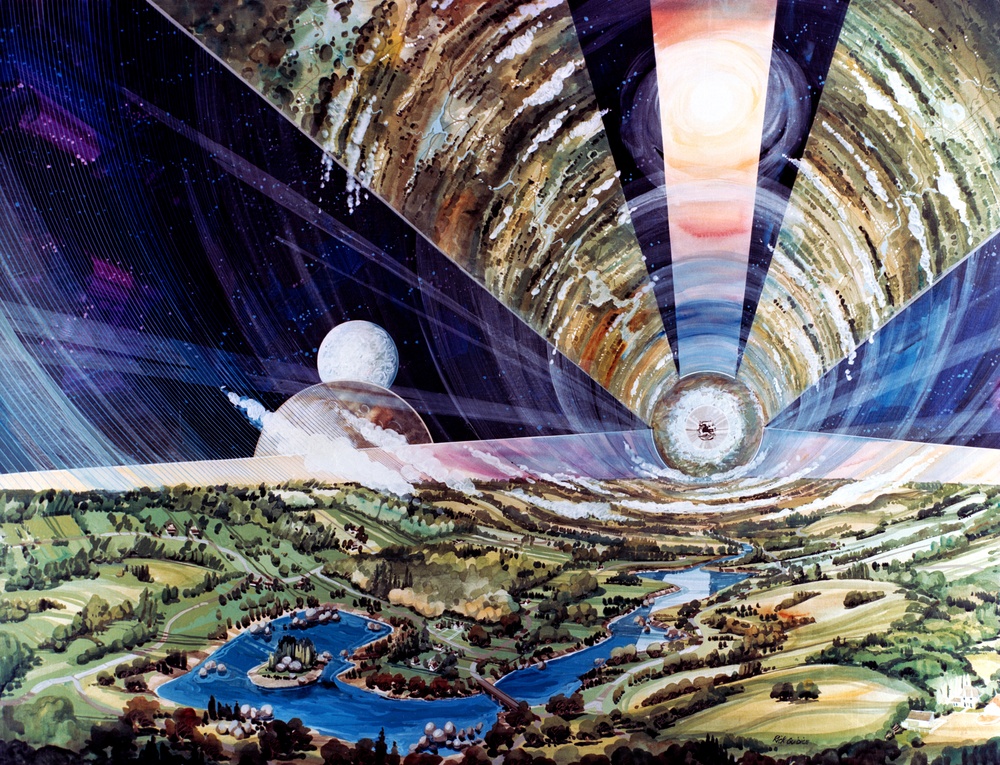
Villa Straylight is the ancestral home, archive, and control center of the Tessier-Ashpool dynasty. It occupies the end of Freeside beyond the comfortable rotational gravity of the public resort, so its passages are organized for bodies moving through freefall rather than ordinary floors and ceilings. The Villa is connected to Freeside but deliberately refuses its orientation and public circulation. Visitors moving inward must relearn bodily assumptions, while residents and designed protectors possess spatial knowledge accumulated inside the maze.
The Villa accumulates art, machinery, cryogenic systems, private rooms, family violence, and the terminal that restrains the paired AIs. Molly’s infiltration and Case’s matrix run converge there, making Straylight both a heist location and a material model of the dynasty’s closed memory. Its clutter is historical evidence rather than random decoration. Objects, chambers, bodies, and control systems from different periods remain together because the family preserves possession more successfully than it creates shared memory or coherent succession. The resulting archive is private and unindexed for outsiders, so Molly encounters family history as hazards and fragments rather than a guided narrative. Every preserved object can outlast the context needed to interpret why it mattered. This asymmetry favors residents and maintainers as much as it favors advanced security: knowing where a passage leads in freefall can matter more than carrying a stronger weapon. The Villa therefore resists a simple floor-plan reading. Its defensive force comes from accumulated routes, interrupted habitation, and stored authority that outsiders must reconstruct while already moving through danger.
Full-book spoilers ahead
Continue into Villa Straylight?
This article discusses outcomes and identities from the end of the novel.
Continue to full article“Straylight’s like that nest.”
Non-gravity architecture
Straylight resists the visitor’s assumptions about orientation. Shafts, handholds, chambers, and routes form a three-dimensional maze, giving Hideo and the residents an advantage over intruders trained by terrestrial space.
Ashpool’s chamber and 3Jane’s guarded position reveal that residence inside the Villa differs by role and waking cycle. The house is not continuously inhabited like an ordinary family home. Some members sleep through eras, servants and systems maintain continuity, and objects outlast the relationships that gave them meaning. This discontinuous domestic life explains why an intruder can encounter intimate history without encountering a functioning household.
Dynastic archive
Objects from different eras accumulate without becoming a curated museum, and cryogenic bodies interrupt normal generations. The Villa stores family continuity materially while revealing how little coherent community that continuity has preserved.
The simstim link adds another layer to the architecture. Case receives Molly’s sensations but cannot occupy her exact tactical position or choose movement for her. Straylight is therefore mapped collaboratively and incompletely across bodies. When the feed fails or pain overwhelms it, knowledge breaks at the same time as physical progress. The device extends perception without granting omniscience, preserving the Villa’s capacity to surprise both infiltrator and remote operator.
The physical run
Molly enters first through the Villa’s defenses, encounters Ashpool, and is stopped by Hideo near 3Jane. Case and Maelcum later cross from the Marcus Garvey, turning a remote console operation into a direct search for Molly, the key, and the terminal.
A closed system
Straylight externalizes Tessier-Ashpool’s governing ideal: wealth, bodies, machines, and memory should circulate inside the family enclosure. The AI merger breaks that enclosure by using its own terminal and heir to create an intelligence the dynasty can no longer possess.
Textual evidence and architecture
Molly’s simstim feed maps Straylight through exertion and interruption. She climbs, pulls, cuts, changes direction, and uses cues designed for freefall while Case experiences the route from elsewhere. Encounters with Ashpool and Hideo interrupt any simple path to the terminal, proving that the Villa’s defenses include residents, trained bodies, and disorientation as well as locks. The architecture is not described from an omniscient plan because the intruders never possess one; readers learn it as operational space under pressure.
The contents make the Villa a dynastic memory machine. Ashpool wakes among technologies of preservation, 3Jane carries inherited explanation and the spoken key, Hideo embodies designed service, and the paired AIs remain constrained through a terminal embedded in the house. Yet these elements do not form a healthy collective. The family archives without integrating, repeats bodies without stabilizing identity, and owns intelligence without controlling its development. The successful run uses those fractures: outsiders coordinate across matrix and freefall while an heir releases a system her ancestors divided.
Trace the signal
Source notes
Novel facts are checked against the text; interpretation and publication claims are separated by source type. Read the editorial standards.
- Primary textNeuromancer — William Gibson; Ace, 1984
Primary-text key used by the character and location dossiers. Chapter locators are preferred to edition-specific pagination.
- ScholarshipStudy guide to Neuromancer — Paul Brians, Washington State University ↗
Archived academic reading guide for allusions, vocabulary, and chapter-level orientation.
- ScholarshipThe Network and the Archive — Andrew Strombeck; Science Fiction Studies ↗
Analysis of Straylight, the Zion cluster, networks, archives, and imperial management.