Freeside
A spindle-shaped orbital resort, free port, and banking center built around tourism and Tessier-Ashpool power.
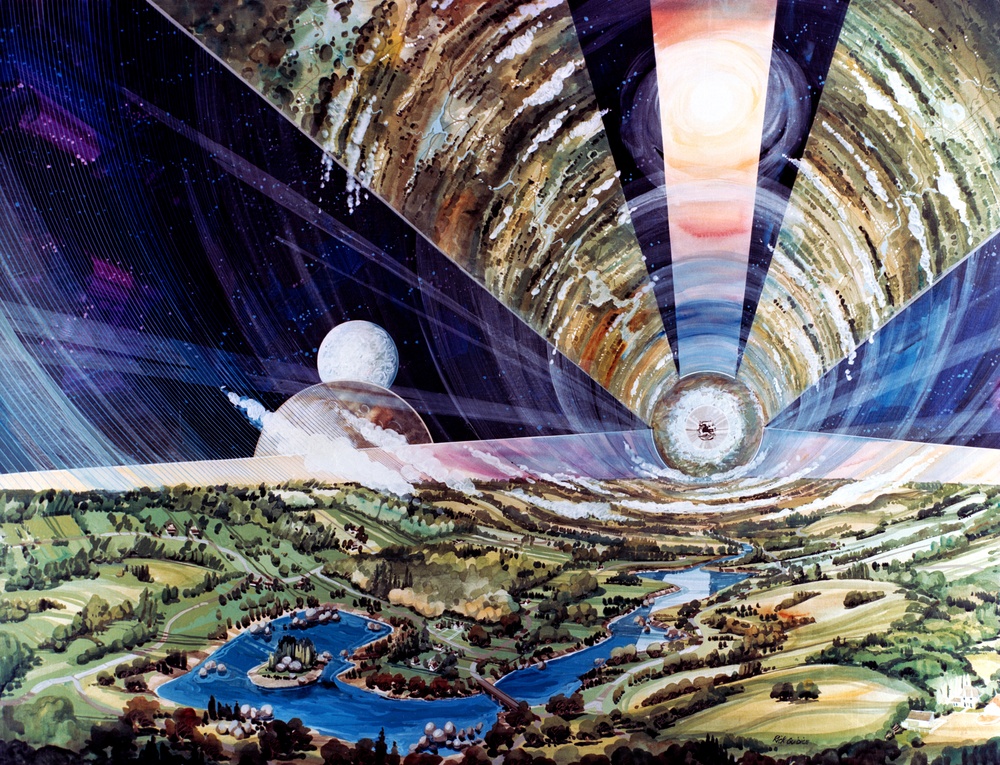
Freeside is a large rotating orbital habitat whose inner surface provides artificial gravity, landscaped streets, hotels, casinos, restaurants, hospitals, and financial services. It sells controlled novelty to wealthy visitors while functioning as a free port and discreet banking center. Its rotation creates a gradient rather than uniform gravity, and movement toward the spindle’s axis changes how bodies and architecture behave. This physical fact organizes social space: the tourist streets occupy comfortable gravity, while specialized transit and elite enclosure extend toward freefall.
At one end of the spindle, Villa Straylight withdraws from the resort’s public life and its rotation. The contrast between curated leisure below and the family’s sealed non-gravity home above turns Freeside into both destination and camouflage for Tessier-Ashpool’s deeper infrastructure. Freeside’s openness is selective. Visitors from many places can enter if they prove credit, yet Turing agents, corporate owners, station security, and private bodyguards remain capable of intervention. Freedom here primarily means commercial permission and jurisdictional convenience. The station welcomes behavior that generates revenue while rapidly isolating conduct that threatens the ownership structure behind the resort. Case experiences both conditions within days, moving from anonymous customer to detained participant in an AI offense. Its celebrated engineering is also a mechanism for sorting access, since reaching some areas requires training, equipment, social invitation, and authorization beyond the means of an ordinary guest. The gap between public hospitality and private rule is not hidden behind a separate facade; it is built into routes, gravity gradients, credit checks, and the narrowing chain of introductions that leads toward 3Jane.
Full-book spoilers ahead
Continue into Freeside?
This article discusses outcomes and identities from the end of the novel.
Continue to full article“Freeside is a brokedown Disneyland for a tired middle class.”
Manufactured world
Rotation produces gravity along the inhabited inner surface, while lighting, vegetation, and recorded sky effects simulate terrestrial comfort. The result is deliberately legible as a designed environment whose apparent outdoors depends on machinery.
The station’s name encourages a frontier reading, but the lived environment is highly administered. Air, gravity, light, vegetation, docking, customs, and credit all depend on coordinated systems. Visitors experience freedom because those systems hide effort and offer choices within a purchased range. The crew’s movement outside that range—to Zionite vessels, Turing custody, and Straylight—reveals how quickly leisure depends on technical and legal boundaries.
Resort and banking economy
Customs primarily tests whether visitors possess sufficient credit, summarizing the station’s political logic. Freeside welcomes many nationalities and appetites so long as they can pay, while its privacy attracts both legitimate wealth and covert operations.
Freeside also rearranges distance. The Villa appears connected to the same spindle, yet reaching it means ascending through changing gravity and controlled passages rather than walking farther along an ordinary street. Social separation is engineered into rotational geometry. Tessier-Ashpool can remain near the resort’s money and services while inhabiting a private spatial regime visitors cannot enter accidentally.
Staging the Straylight run
The crew disperses through hotels, restaurants, clubs, spacecraft, and cyberspace positions before converging on Straylight. Case’s detention by Turing agents proves that the resort’s permissiveness has limits when AI regulation is threatened.
Public pleasure and private power
Freeside’s busy public surface depends on a corporate dynasty hidden at its end. The station’s layout makes social hierarchy spatial: tourists circulate through designed streets, while Tessier-Ashpool occupies a private labyrinth outside ordinary gravity.
Textual evidence and contrasts
Arrival supplies a sequence of designed reassurances: customs reduces eligibility to credit, a familiar coffee franchise appears on the inner surface, vegetation softens the built canyon of Rue Jules Verne, and a recorded sky helps visitors treat rotation as landscape. Case still feels the curvature and changing perspective, so the machinery never vanishes completely. Freeside’s achievement is not perfect imitation of Earth but a commercially useful balance between comfort and visible novelty.
The run exposes infrastructures behind that hospitality. Zionite craft dock outside the tourist route, Cath and Bruce operate an informal drug market, Riviera converts a restaurant audience into access to 3Jane, Turing officers pursue Case, and Villa Straylight controls the station from a spatially separate end. These scenes support the description of Freeside as resort, free port, and banking nexus while showing that each function serves different users. The public avenue is neither a false facade nor the whole station; it is the legible layer through which deeper systems recruit money and conceal ownership.
Trace the signal
Source notes
Novel facts are checked against the text; interpretation and publication claims are separated by source type. Read the editorial standards.
- Primary textNeuromancer — William Gibson; Ace, 1984
Primary-text key used by the character and location dossiers. Chapter locators are preferred to edition-specific pagination.
- ScholarshipStudy guide to Neuromancer — Paul Brians, Washington State University ↗
Archived academic reading guide for allusions, vocabulary, and chapter-level orientation.
- ScholarshipThe Network and the Archive — Andrew Strombeck; Science Fiction Studies ↗
Analysis of Straylight, the Zion cluster, networks, archives, and imperial management.