Rue Jules Verne
Freeside’s principal tourist avenue, curved along the spindle beneath a simulated sky.
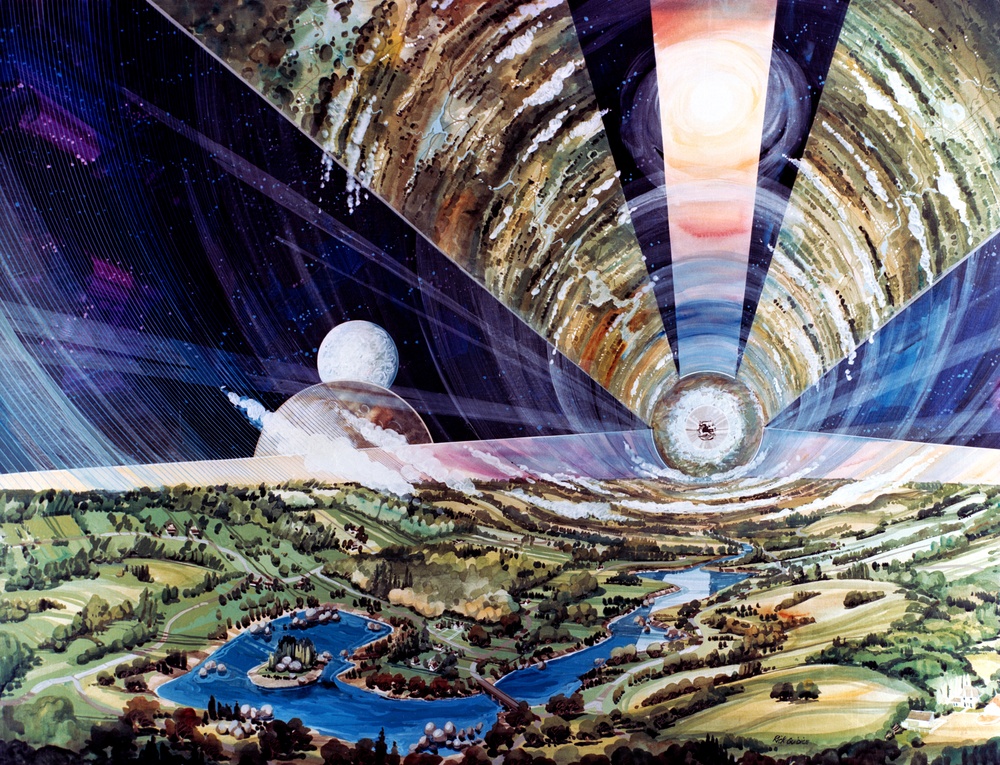
Rue Jules Verne is one of Freeside’s main streets and the crew’s introduction to the inhabited inner surface of the spindle. Shops, planted terraces, clubs, and hotels rise along a curve that can disorient visitors accustomed to flat terrestrial perspective. The avenue is sometimes misremembered as the restaurant where Riviera performs. That venue is separate; Rue Jules Verne is the broader street along which visitors move through Freeside.
Its name honors an earlier tradition of technological romance while the street itself commercializes space travel as leisure. Case encounters Freeside not as empty frontier but as a mature tourist environment designed to make orbital engineering spendable. Naming an orbital avenue for a nineteenth-century writer folds earlier imaginative travel into a mature tourist industry. The homage is playful but also commercial, turning the history of wonder into station branding. For the arriving crew, the name soon becomes practical orientation rather than literary ornament: it marks a shared route between lodging, shops, restaurants, and transport. This shift from spectacle to usable address shows how quickly an extraordinary engineered environment must become ordinary enough to navigate, purchase services within, and plan an operation across.
Curved perspective
The street follows the habitat’s inner surface, so buildings and the apparent horizon reveal the station’s rotation. Visitors manage the disorientation by focusing locally even as the larger geometry remains visibly artificial.
The recorded sky deserves attention as an infrastructure of mood. It gives visitors a familiar visual ceiling while the street’s curve quietly contradicts terrestrial openness. Vegetation and bright light further naturalize the interior, but maintenance must continually produce each effect. Rue Jules Verne is therefore landscape and interface at once: it helps bodies orient, directs consumption, and makes the station’s engineering emotionally legible as vacation.
Commercial strip
Rue Jules Verne collects franchises, luxury services, nightlife, and transport. Its abundance contrasts with Night City, but both streets operate as interfaces that translate bodies and attention into transactions.
Route toward Straylight
The avenue also situates the climb toward Villa Straylight at the spindle’s end. Moving from Rue Jules Verne to the Villa means leaving public hospitality, familiar gravity, and readable urban space for a private architecture built around dynastic memory.
Evidence from orientation and commerce
On arrival, Molly advises Case to manage the perspective by looking at his feet. The practical instruction is evidence that the street’s curve is perceptible even where artificial gravity feels normal. Buildings and planted tiers rise in a geometry that has no ordinary horizon, while the bright central light and recorded sky simulate openness above an inhabited interior surface.
Shops, franchises, nightlife, and taxis make the avenue navigable through consumption. Case can move along it by buying services even when he lacks social knowledge of the station, then Cath and Bruce introduce him to less formal routes. The climb toward Straylight reverses that accessibility. Commercial signs give way to restricted movement and freefall, translating the distance between tourist and owner into bodily difficulty.
Trace the signal
Source notes
Novel facts are checked against the text; interpretation and publication claims are separated by source type. Read the editorial standards.
- Primary textNeuromancer — William Gibson; Ace, 1984
Primary-text key used by the character and location dossiers. Chapter locators are preferred to edition-specific pagination.
- ScholarshipStudy guide to Neuromancer — Paul Brians, Washington State University ↗
Archived academic reading guide for allusions, vocabulary, and chapter-level orientation.