Night City
The unofficial Chiba border district centered on Ninsei and its after-dark service economy.
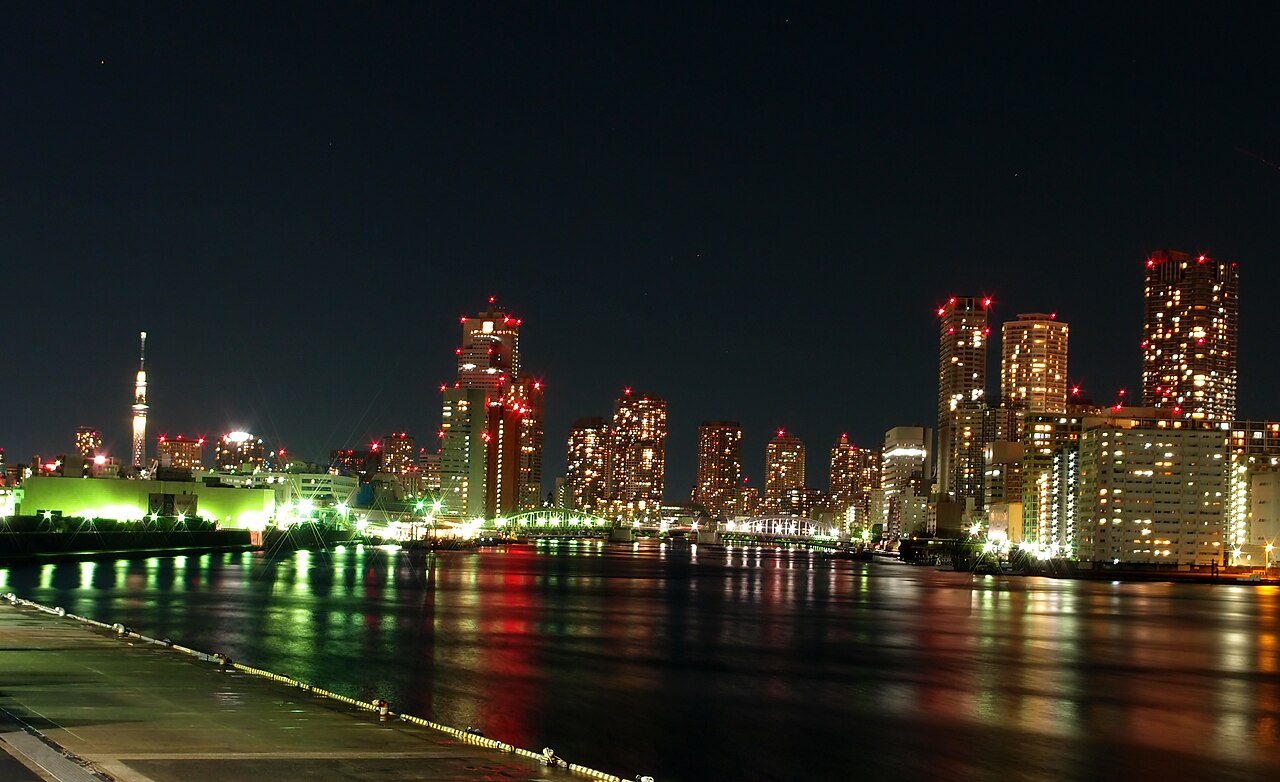

Night City is the unofficial district between Chiba’s port and its corporate arcologies, with Ninsei at its heart. The name describes a social and economic zone rather than a separately governed municipality. This Night City belongs to Gibson’s Chiba geography and should not be conflated with the later city of the same name in the Cyberpunk game franchise. Shared genre influence does not make the settings one canon.
Its shutters, bars, holograms, clinics, capsule rooms, and street deals become fully active after dark. Case experiences it as both familiar territory and a closed circuit in which his damaged nerves, drug use, and debts are driving him toward death. Its unofficial status also makes boundaries porous. A street can move from tourist service to contraband exchange within a few doors, while port workers, corporate technicians, expatriates, and local criminals share venues without sharing security or power.
An unofficial borderland
Night City occupies the seam between internationally connected port traffic and sealed corporate production. Its lack of a formal name does not mean it lacks order; reputation, money, gangs, and service relationships provide a different kind of governance.
Named characters anchor that informal order. Ratz holds a stable social position behind the Chatsubo bar, Wage extends credit and threat through criminal business, Deane sells accumulated information, and Linda and Case move goods at the precarious edge. None governs the district, but together their repeated transactions create expectations. Night City’s apparent disorder is thus a dense field of small authorities whose reach changes from venue to venue.
Day and night
By day, Ninsei’s neon and holograms are inert beneath a polluted sky. At night the same surfaces become a dense field of signals, demonstrating how the district’s architecture is activated by attention and commerce rather than transformed physically.
Case’s territory
Case knows the district’s routes and codes but has lost the professional status that once let him leave local crime for cyberspace. His familiarity therefore becomes claustrophobic: every contact knows some version of his decline, and every deal narrows his options.
Evidence of an informal district
The novel defines Night City relationally: it lies between the port and corporate arcologies, and its center is Ninsei. That description supplies no municipal border, government, or official map. Instead, repeated routes connect bars, hotels, clinics, vendors, and warehouses into a district recognizable to residents. The name is social infrastructure, allowing Case and others to refer to a pattern of business that formal Chiba does not need to acknowledge.
Case reads the district fluently but not infallibly. He can identify where to sell goods, find a drug, hide equipment, or hear a rumor, yet manipulation travels along the same trusted channels. Linda’s theft, the reported threat from Wage, and information associated with Deane show how familiarity can be weaponized. Night City is therefore neither chaotic nor transparent. Its order depends on local knowledge whose sources always have interests of their own.
Trace the signal
Source notes
Novel facts are checked against the text; interpretation and publication claims are separated by source type. Read the editorial standards.
- Primary textNeuromancer — William Gibson; Ace, 1984
Primary-text key used by the character and location dossiers. Chapter locators are preferred to edition-specific pagination.
- ScholarshipStudy guide to Neuromancer — Paul Brians, Washington State University ↗
Archived academic reading guide for allusions, vocabulary, and chapter-level orientation.