Ninsei
The main street and social spine of Night City, lined with bars, signs, vendors, and transient business.
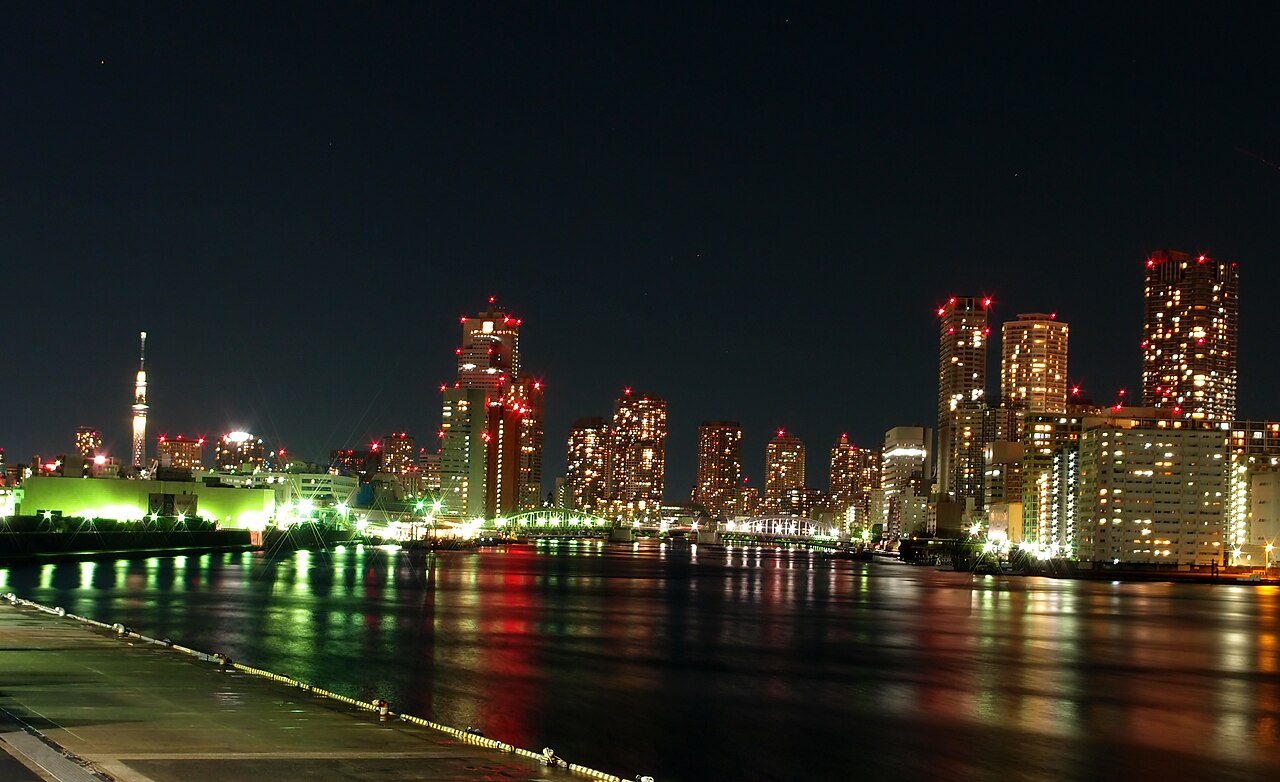

Ninsei is the street at the center of Night City’s after-dark economy. The Chatsubo and other bars open onto it, and Case repeatedly uses it as both a route and a source of information about who is working, buying, following, or hiding. Ninsei is sometimes treated as shorthand for all of Night City, but the text more carefully makes it the district’s heart. Other named routes, including Baiitsu and Shiga, connect it to lodging, port traffic, and transactions beyond the bar strip.
The street’s famous visual density is functional rather than decorative. Neon, holograms, shop fronts, languages, and crowds compete to direct attention, turning public space into an interface for informal commerce. Case’s attention to signs and moving bodies turns walking into a kind of low-speed navigation. Unlike cyberspace, however, every signal is attached to weather, fatigue, intoxicants, and the possibility of being physically followed. Because his decisions happen on foot, the street records his declining condition in missed cues and repeated routes. Ninsei is not simply scenery behind his paranoia; it is the physical medium through which incomplete information becomes pursuit, error, and bodily danger.
The street as interface
Ninsei presents information through signs, bodies, prices, and movement. Case reads those signals with the same professional alertness he once applied to cyberspace, though street knowledge offers no clean separation from physical danger.
The street’s visual excess also has a linguistic dimension. Ideograms, imported names, brand marks, and spoken languages address a population shaped by port and corporate traffic. Case does not pause to translate every sign because partial comprehension is normal. Ninsei’s readability comes from pattern, price, and habit as much as literal text, much as matrix operators learn spatial conventions that conceal underlying code.
Business network
Bars, stalls, dealers, and hotels depend on one another’s traffic. Transactions that look casual are embedded in longer chains of credit and enforcement connecting people such as Ratz, Wage, Deane, Case, and Linda Lee.
Visual legacy
Ninsei is frequently reduced in later cyberpunk imagery to rain and neon. In the novel, its more important qualities are mixture and reuse: advanced display systems sit over aging buildings, and global technology serves intensely local needs.
Evidence from the street’s rhythm
Day and night provide the clearest textual comparison. In daylight the bars are sealed and display systems inert; darkness activates businesses and audiences. The change reveals that neon is an economic instrument before it is a genre emblem. Signs compete because Ninsei contains many small claims on transient attention, and the people reading them may not share a language or remain in Chiba for long.
Several early decisions are made while Case moves along or away from Ninsei, including drug use, disposal of a weapon, calls, and attempts to assess surveillance. The street is thus part of narrative cognition: distance between venues gives fear time to become certainty. Mapping those movements prevents the opening from collapsing into montage and shows how Case’s local expertise coexists with a rapidly deteriorating ability to judge risk.
Trace the signal
Source notes
Novel facts are checked against the text; interpretation and publication claims are separated by source type. Read the editorial standards.
- Primary textNeuromancer — William Gibson; Ace, 1984
Primary-text key used by the character and location dossiers. Chapter locators are preferred to edition-specific pagination.
- ScholarshipStudy guide to Neuromancer — Paul Brians, Washington State University ↗
Archived academic reading guide for allusions, vocabulary, and chapter-level orientation.
- ReferenceCyberpunk — The Encyclopedia of Science Fiction ↗
Stable alias used in the article corpus for the movement and its terminology.